



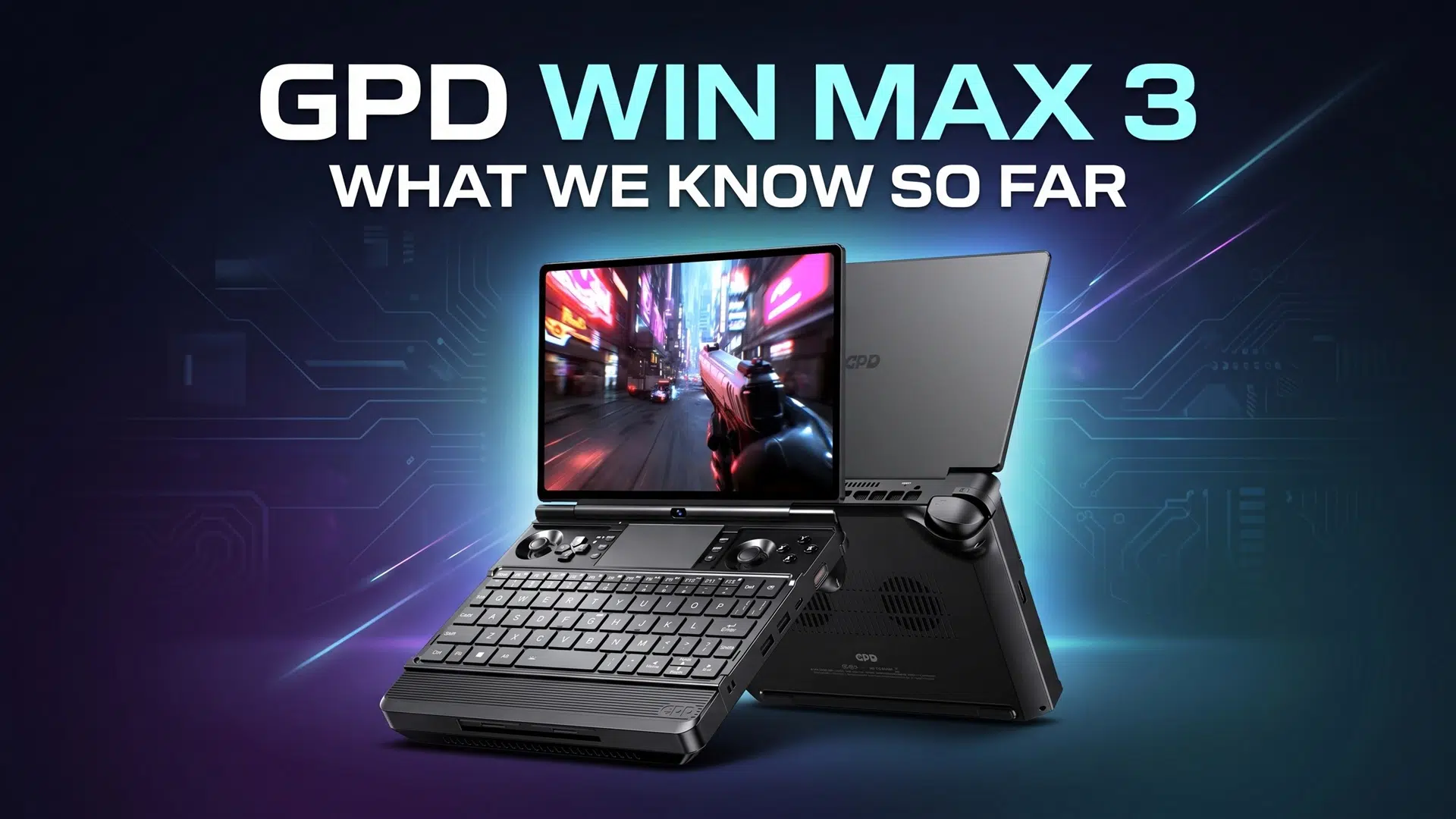
What is the GPD WIN MAX 3?
The GPD WIN MAX 3 is an upcoming 9.06-inch handheld gaming PC detailed in our source material with AMD Ryzen AI Max+ processors, Radeon 8060S graphics, a 165Hz AMOLED display, modular battery and cooling hardware, and a built-in keyboard-and-controller layout.
This article is not based on GPD Store hands-on testing. It is a source-led technical preview, so final pricing, bundle contents, availability, retail configurations, and real-world performance should still be treated as details that need confirmation.
For anyone comparing a portable gaming PC with a mini laptop and a travel productivity machine, the platform direction is the key story. The GPD WIN MAX 3 is being framed less like a simple compact clamshell and more like a high-power Strix Halo handheld laptop with modular power, modular cooling, and unusually flexible storage.
GPD WIN MAX 3 dimensions, weight and modular laptop design
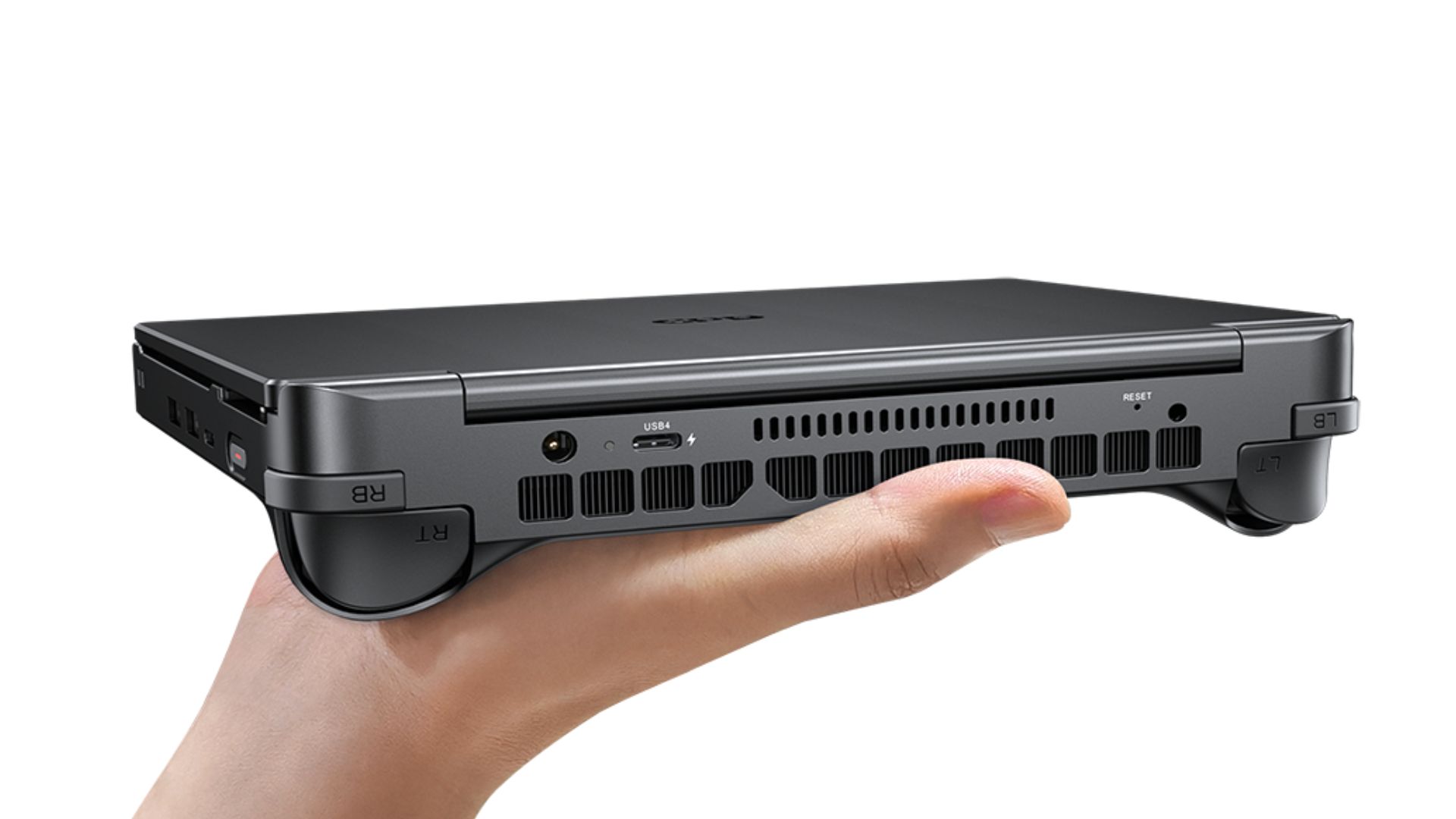
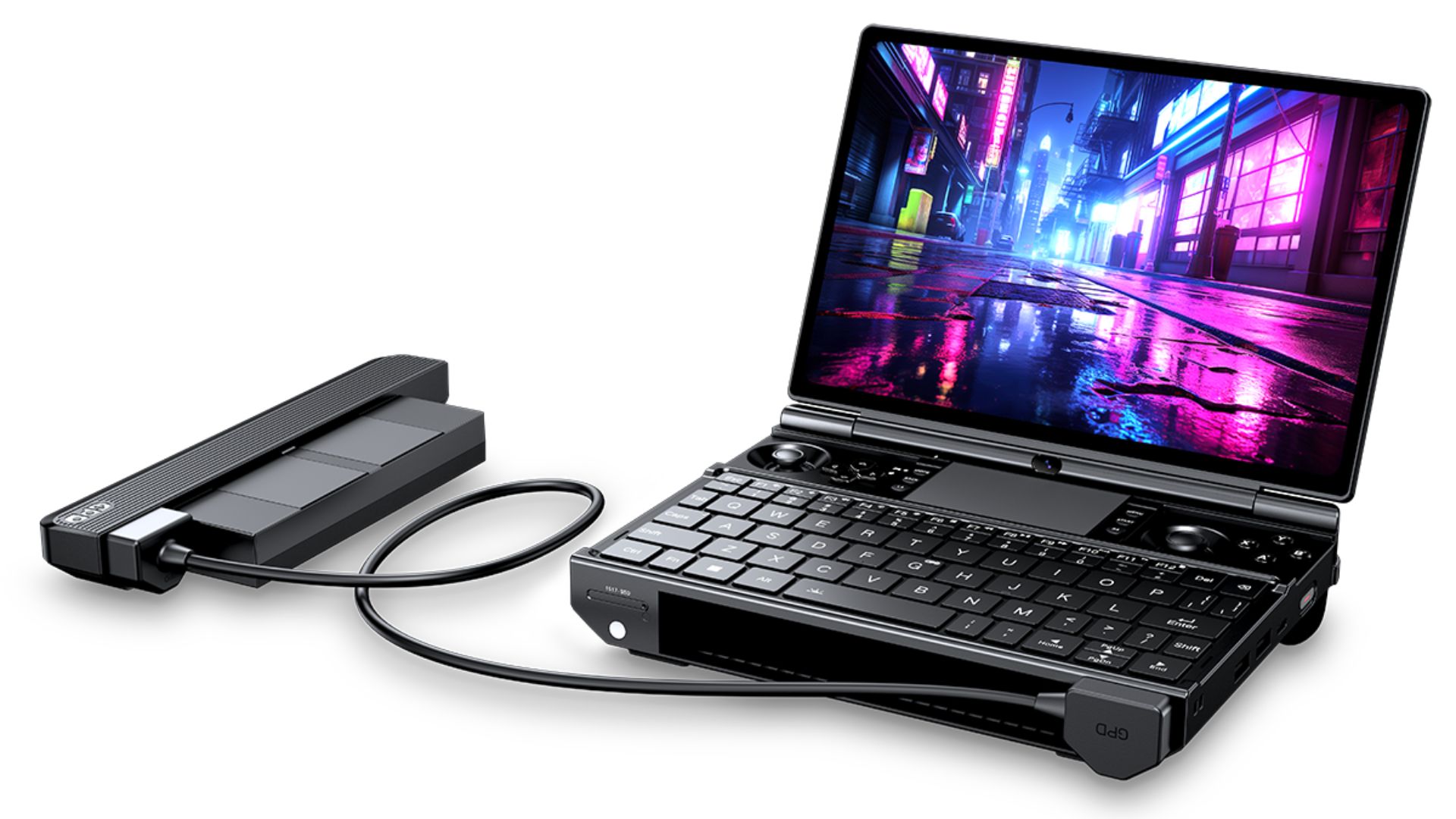
Our sources give the GPD WIN MAX 3 a listed size of 207×147×34mm without modules and 207×180×34mm when modules are attached. The listed weight is 815g for the base unit, 1,220g with the external battery module, and 985g with the external fan module.
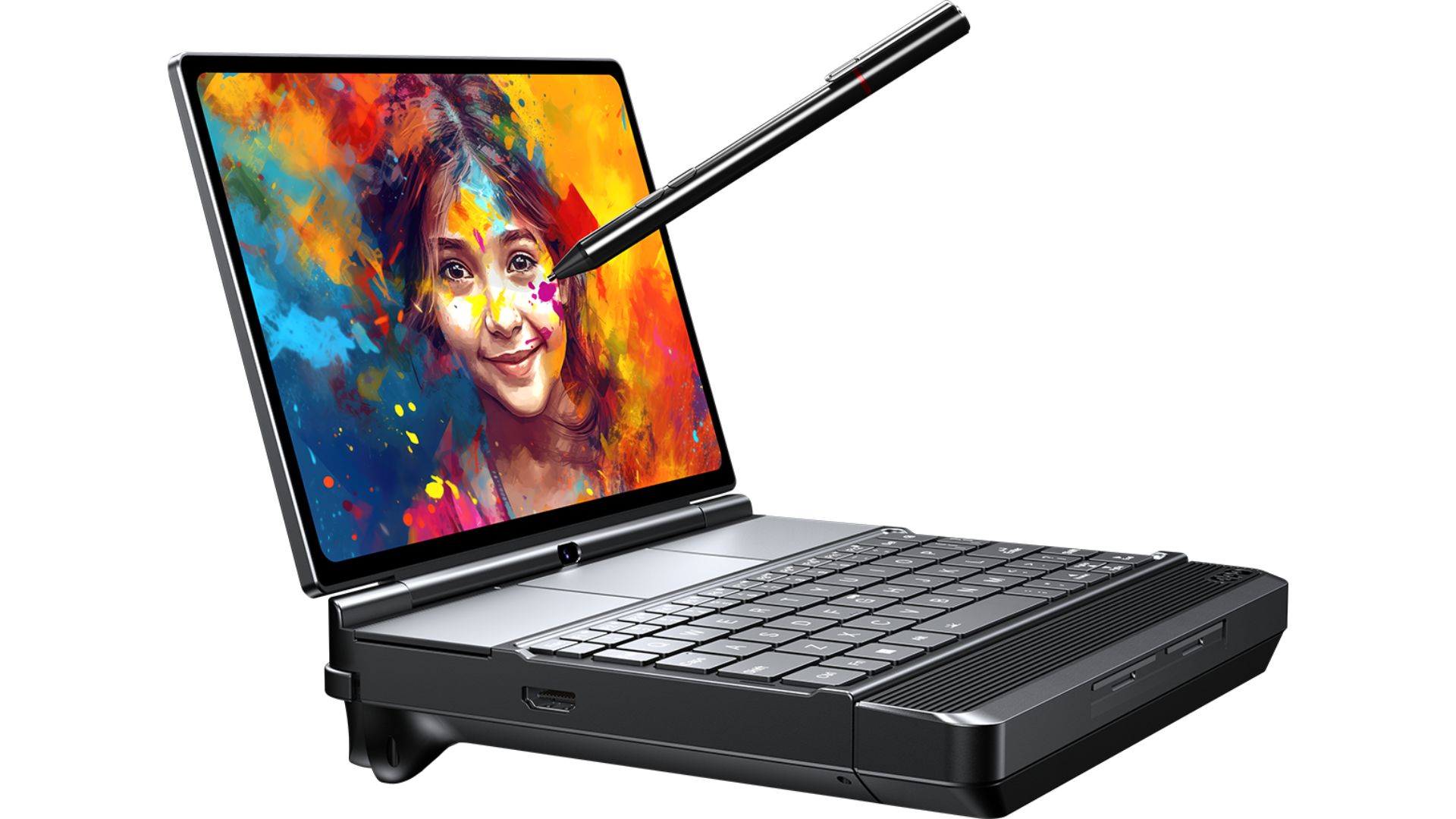
Those figures make the base device smaller in footprint than the GPD WIN MAX 2 2025, while the attached modules add size and weight when you want longer runtime or more cooling headroom. The same comparison material lists the WIN MAX 2 2025 at 227×160×23mm and 1,005g with its built-in battery.
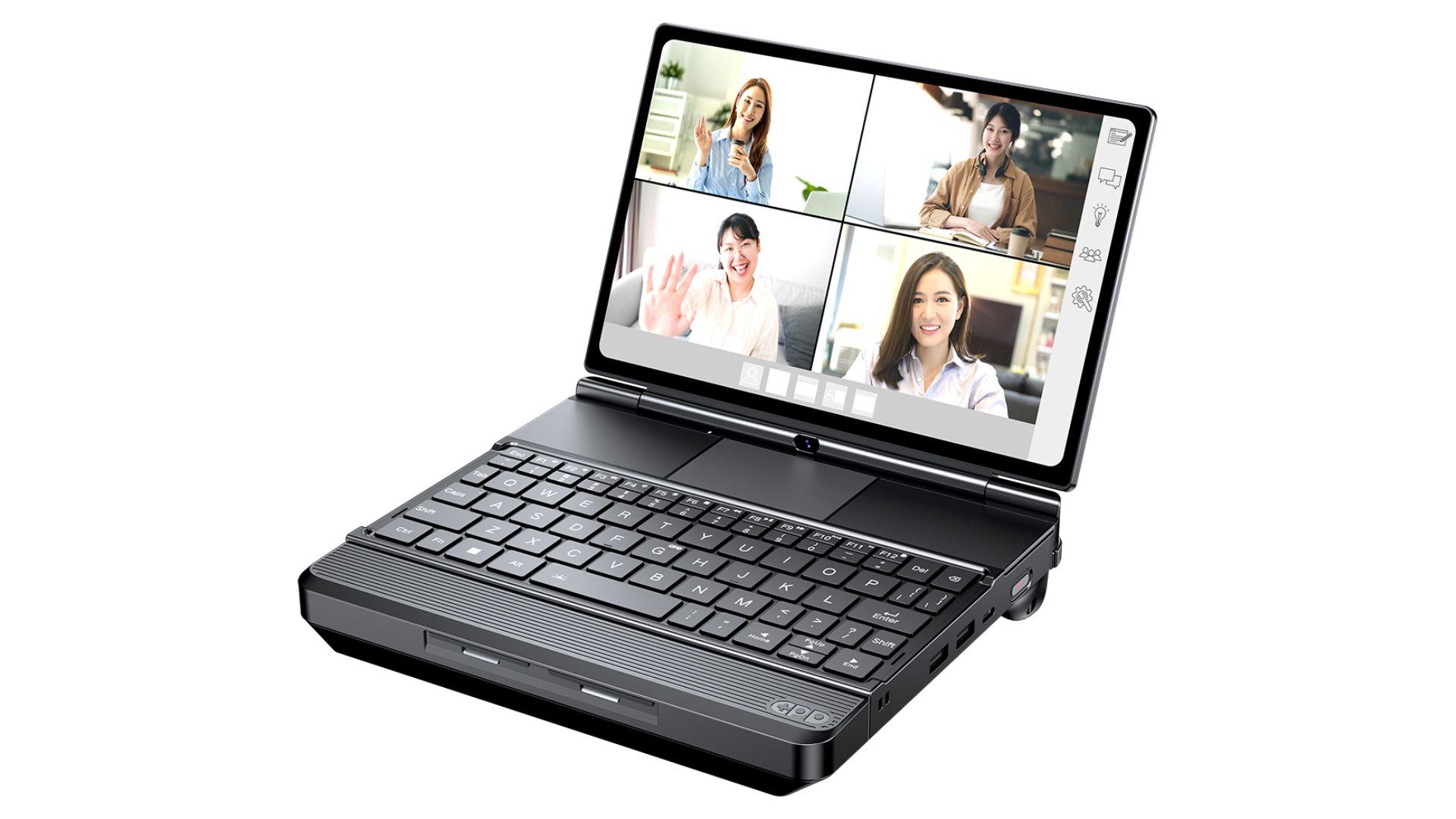
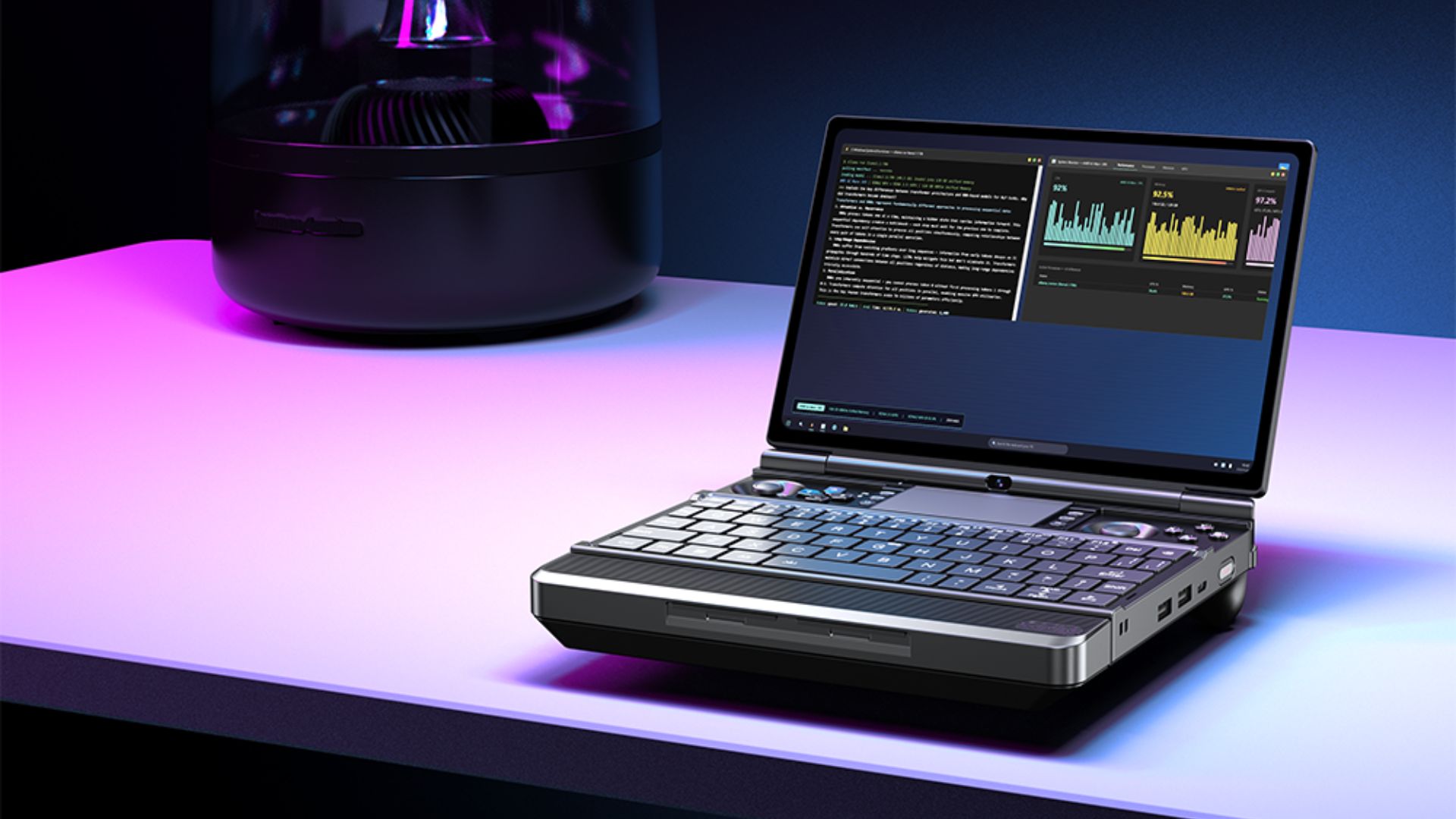
The overall design still follows the Max-series idea of a small laptop with gaming controls built in. What changes is the modular approach: you can keep the machine in a lighter laptop-style setup, attach the 97Wh battery module for extended use away from a charger, or use the fan module when sustained power matters more than minimum weight.
| Configuration | Listed size | Listed weight | Main use case |
|---|---|---|---|
| Base unit without modules | 207×147×34mm | 815g | Lighter laptop-style use and shorter gaming sessions |
| With battery module | 207×180×34mm | 1,220g | Longer unplugged sessions using the 97Wh external battery |
| With fan module | Not separately stated beyond module depth | 985g | Higher sustained performance with external cooling |
| GPD WIN MAX 2 2025 comparison | 227×160×23mm | 1,005g | Previous-generation clamshell handheld baseline |
9.06-inch AMOLED display with 165Hz, HDR10 and Real RGB clarity
The display is one of the strongest specification changes listed for GPD WIN MAX 3. Our sources describe a 9.06-inch AMOLED screen with a 2400×1504 resolution, 313 PPI pixel density, 165Hz refresh rate, HDR10 support, and Real RGB sub-pixel structure.
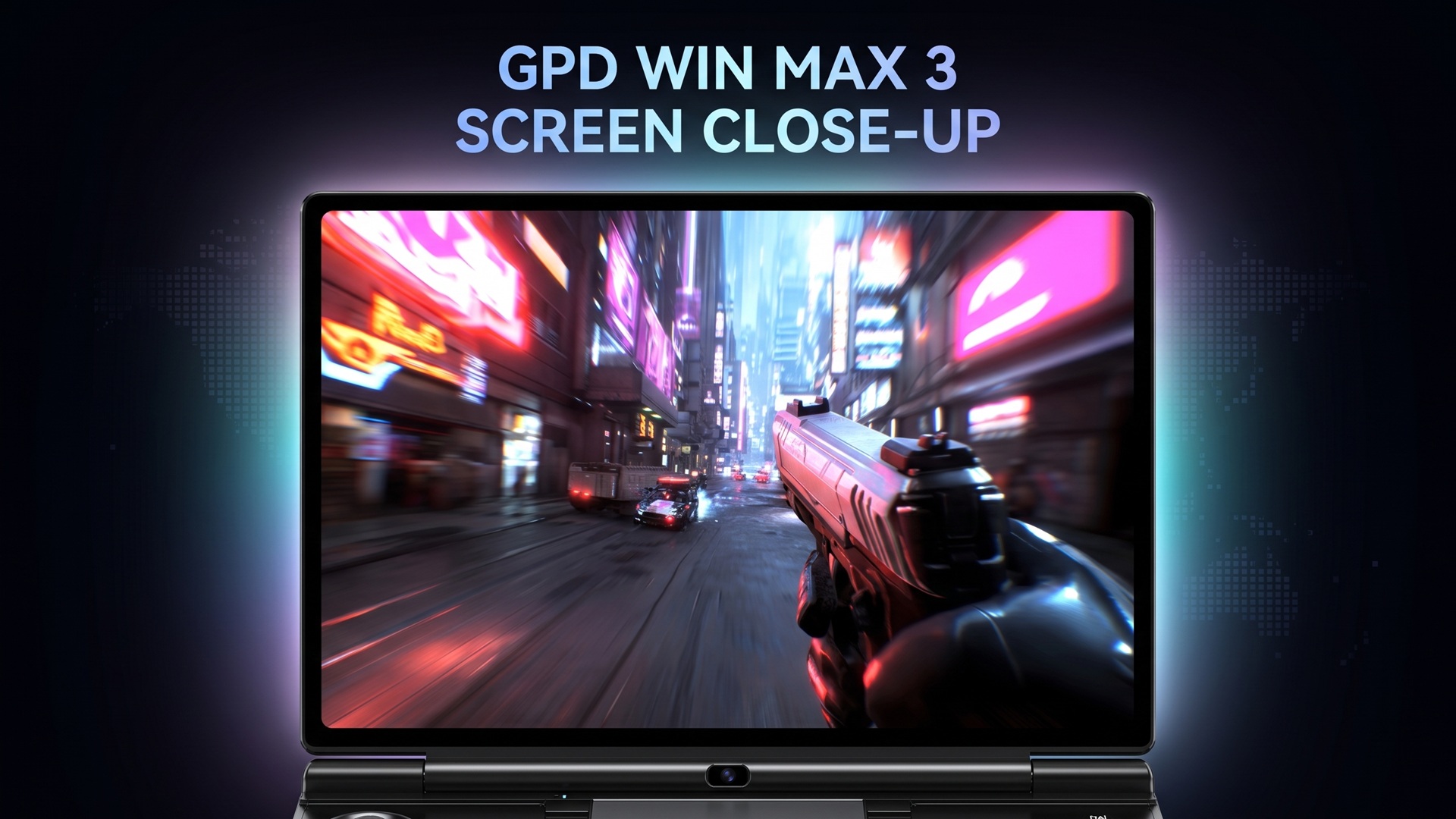
The same material says the panel can use HDR and 165Hz at the same time, with selectable refresh modes of 165Hz, 144Hz, 120Hz, and 60Hz. Other listed screen details include 650 nits standard brightness, 1050 nits peak HBM brightness, 1,000,000:1 contrast, DCI-P3 105%, sRGB 150.72%, NTSC 108.52%, 10-bit colour, and factory colour accuracy below ΔE 1.
The Real RGB point is worth highlighting because the GPD WIN MAX 3 is also a Windows productivity device, not just a gaming screen. A full RGB triad per pixel should help text, menus, UI elements, and desktop work look cleaner than a PenTile-style layout, provided final hardware matches the listed panel specification.
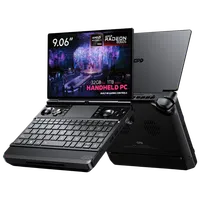

GPD WIN Max 3
Windows Handhelds
Processor ModelRyzen™ AI Max+ 388
Memory / Capacity32GB
Storage / Capacity1TB



 on 4 stores
Display specification summary
| Display feature | Listed specification |
|---|---|
| Size | 9.06 inches |
| Resolution | 2400×1504 |
| Refresh rate | 165Hz, 144Hz, 120Hz, 60Hz tiers |
| Panel type | AMOLED, Real RGB |
| Pixel density | 313 PPI |
| HDR | HDR10, PQ metadata and static metadata listed |
| Brightness | 650 nits standard, 1050 nits peak HBM |
| Touch and protection | 10-point touch, active stylus support, Gorilla Glass 6 |
AMD Ryzen AI Max+ 395 and Ryzen AI Max+ 388 CPU options
Two AMD processor choices are listed for the GPD WIN MAX 3: Ryzen AI Max+ 395 and Ryzen AI Max+ 388. Both are Zen 5 Strix Halo chips built on a 4nm process, with a listed 45W to 110W dynamic TDP range and a 50 TOPS NPU.
The Ryzen AI Max+ 395 is the higher-core option, listed with 16 cores, 32 threads, a 3.0GHz base clock, a 5.1GHz boost clock, 81.25MB total cache, and 126 TOPS total compute. The Ryzen AI Max+ 388 is listed with 8 cores, 16 threads, a 3.6GHz base clock, a 5.0GHz boost clock, 40.6MB total cache, and 118 TOPS total compute.
Users with heavy multi-core workloads will naturally look first at the Ryzen AI Max+ 395 because of its doubled core and thread count. The Ryzen AI Max+ 388 may still be attractive if it offers the same wider platform at a different price point, but final recommendations should wait for confirmed SKUs, pricing, and real-world tests.
| CPU option | Cores / threads | Base / boost | NPU | Listed TDP range | Architecture |
|---|---|---|---|---|---|
| Ryzen AI Max+ 395 | 16C / 32T | 3.0 / 5.1GHz | 50 TOPS | 45W–110W | Zen 5, Strix Halo |
| Ryzen AI Max+ 388 | 8C / 16T | 3.6 / 5.0GHz | 50 TOPS | 45W–110W | Zen 5, Strix Halo |
Radeon 8060S graphics and source-provided gaming performance claims
Both listed CPU configurations use AMD’s Radeon 8060S integrated graphics. The supplied details list 40 compute units, 2560 shader units, a 2.9GHz maximum GPU clock, 32MB MALL cache, DirectX 12 Ultimate, Vulkan 1.3, OpenGL 4.6, and USB4 8K@60Hz output support.
The benchmark section in our source material positions the Radeon 8060S against several 55W mobile discrete GPUs in 3DMark Time Spy and Fire Strike graphics tests. These numbers are source-provided figures rather than GPD Store test results, so they should be treated as stated claims until final hardware is independently benchmarked.
The same source also lists 1080p gaming figures across more than 30 titles, from 42fps in Microsoft Flight Simulator 2024 at medium settings to 192fps in Apex Legends at ultra settings. The listed test platform is Ryzen AI Max+ 395, 64GB LPDDR5x 8000 MT/s, 1TB NVMe SSD, 55–75W TDP, 1080p at 165Hz, Windows 11 Home, and DX12.
LPDDR5x 8000 memory, unified VRAM and local AI potential
Memory is another area where the GPD WIN MAX 3 moves beyond many older compact Windows handhelds. Our sources list 32GB, 64GB, and 128GB LPDDR5x 8000 MT/s options in a quad-channel layout, with claimed peak bandwidth of 256GB/s.
That bandwidth is especially relevant because the Radeon 8060S uses shared system memory rather than separate VRAM. The source material presents the quad-channel LPDDR5x 8000 design as a major reason the 8060S can compete with lower-power discrete mobile GPUs in the listed comparisons.
The 128GB model is also being positioned for local AI work. According to the supplied details, up to 96GB can be allocated as unified VRAM, with examples given for 70B-class and larger quantised models. These AI workload figures should remain caution-tagged until final software behaviour, thermal limits, and configuration options are tested.
M.2 2280, M.2 2230 and Mini SSD 1517 storage expansion
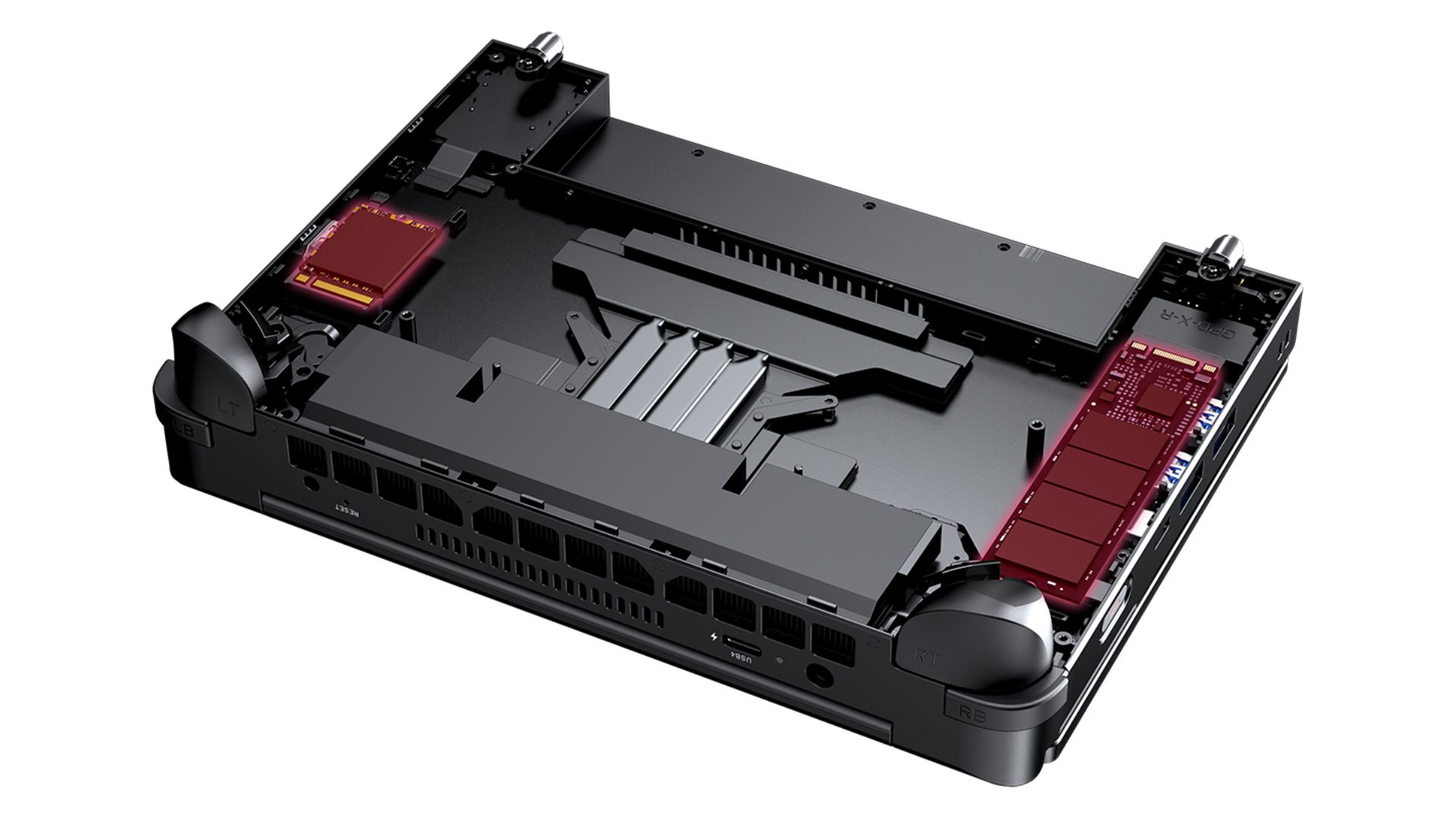
The GPD WIN MAX 3 storage setup is more flexible than expected for a device of this size. Our sources list a factory-installed M.2 2280 PCIe 4.0×4 NVMe slot, an empty M.2 2230 PCIe 4.0×2 slot for user expansion, and a Mini SSD 1517 slot.
The M.2 2280 slot is listed with up to 7,880MB/s theoretical read speed and up to 6,900MB/s theoretical write speed, depending on the drive used. The M.2 2230 slot is listed with up to 3,940MB/s theoretical read speed and support for mainstream 2230 SSDs.
Mini SSD 1517 is the more distinctive storage addition. The source material describes it as a 15×17mm PCIe Gen4×1 expansion card format with up to 2TB capacity and up to 1600MB/s sequential read/write performance, positioning it as a much faster compact alternative to microSDXC-style storage.
| Storage option | Interface | Listed role | Listed theoretical speed |
|---|---|---|---|
| M.2 2280 | PCIe 4.0×4 NVMe | Factory pre-installed SSD slot | Up to 7,880MB/s read |
| M.2 2230 | PCIe 4.0×2 NVMe | Empty user expansion slot | Up to 3,940MB/s read |
| Mini SSD 1517 | PCIe Gen4×1 | Compact removable-style expansion | Up to 1600MB/s sequential R/W |
For anyone using a compact Windows system as a mobile gaming PC, storage flexibility can matter as much as GPU performance. Large PC games, emulator libraries, captured media, project files, and local AI models can all fill a drive quickly, so the three-route expansion approach is a practical advantage.
97Wh external battery module and dual-fan cooling module
Our sources describe a 97Wh modular external battery based on what is called FlexPower Flexible Power Technology. The battery module attaches magnetically and is listed at 405g, bringing the device to 1,220g when the battery module is fitted.
The same material also describes a magnetic extension cable that lets the battery power the unit without being attached directly to the rear shell. If it works as described, this could make desk, sofa, and travel use more comfortable by moving battery weight away from the hands.
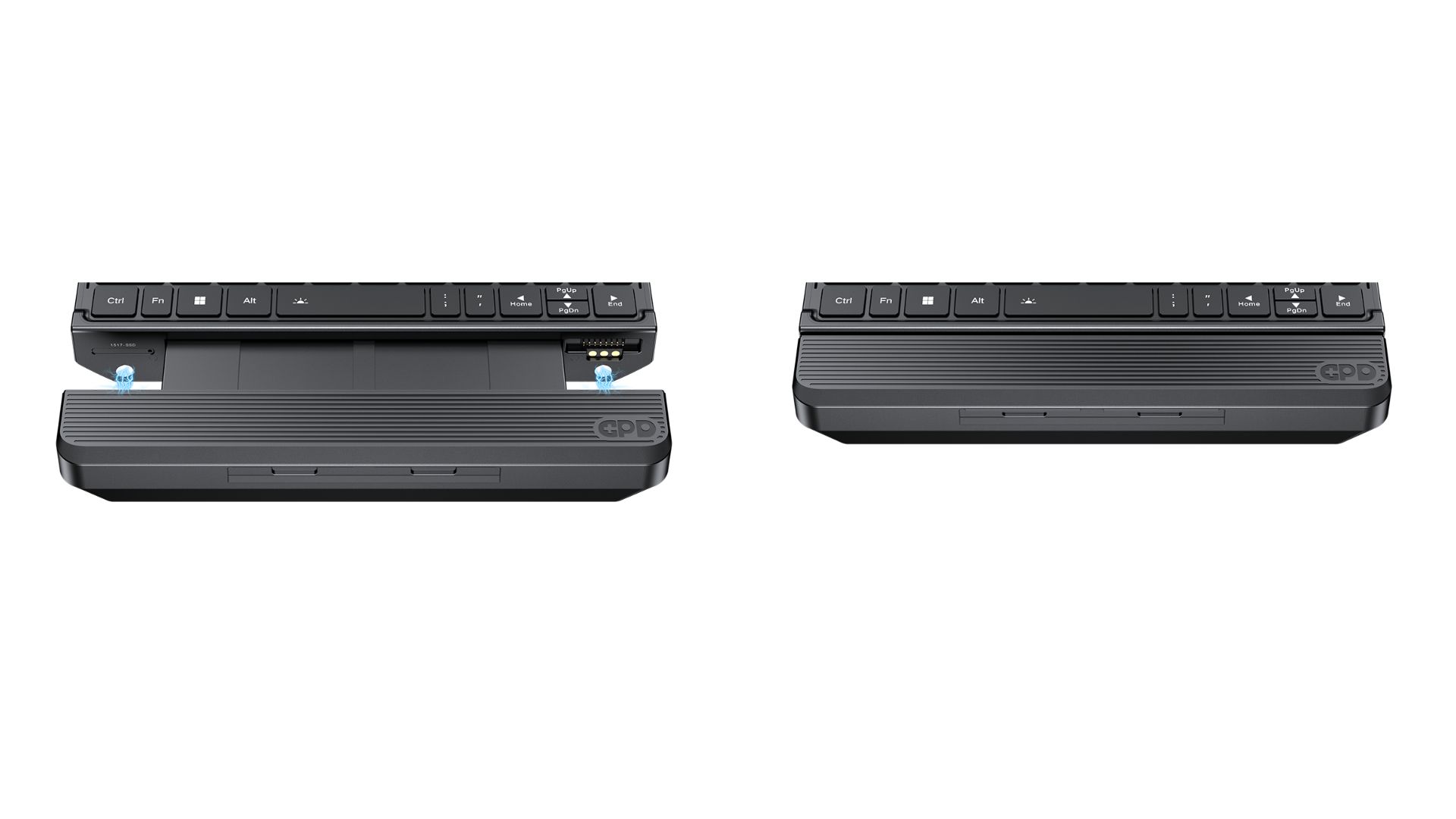
Cooling is handled by both the internal thermal design and an external fan module. Internally, the source material lists a second-generation PC-grade large turbo fan with a thickened pure copper four-heatpipe system, while the detachable fan module is described as the route to up to 110W sustained platform performance.
180W DC power, 100W USB4 PD and bypass power use
The GPD WIN MAX 3 power system is clearly designed for high-power operation. Our sources list a 180W DC adapter for full-performance use and 100W USB4 PD 3.0 fast charging for lighter travel charging.
The device is also described as being able to run directly from the DC adapter even if the battery module is removed or depleted. A custom charge limit feature is also mentioned, including an example such as stopping charge at 80%, which is intended to reduce long-term battery wear during extended plugged-in use.
That power design makes sense for a compact gaming PC that may be handheld one moment, docked the next, and used as a small laptop for work in between. It also fits the wider expansion theme, especially for users connecting USB4 docks, external displays, or eGPU hardware.
Capacitive joystick, Hall triggers and full Xbox-style controls
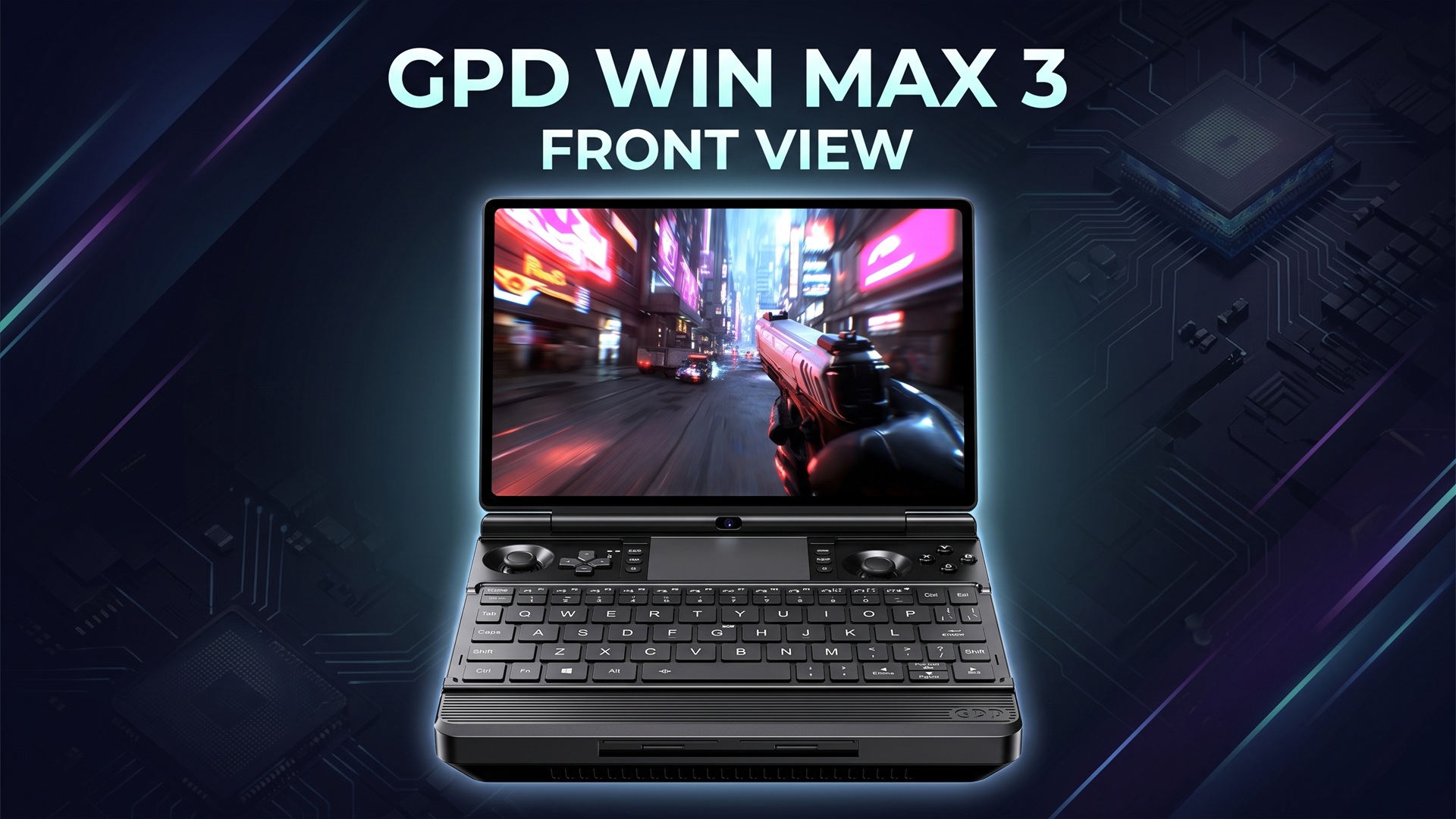
The GPD WIN MAX 3 retains the Max-series gamepad area but raises the listed control specification. Our sources list capacitive joysticks, linear Hall triggers, two programmable rear buttons, a 6-axis gyroscope, and a full Xbox-style controller layout.
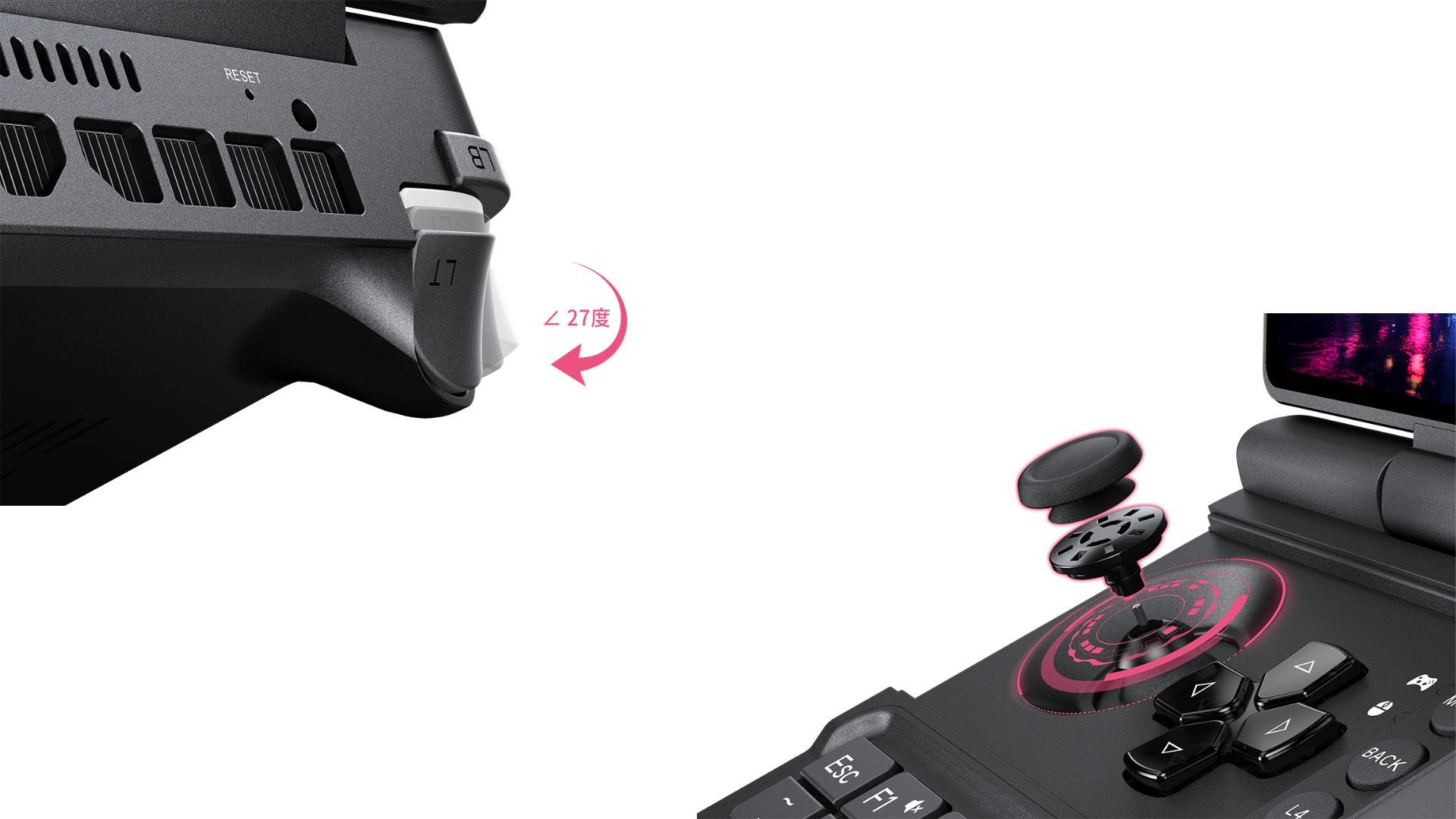
The capacitive joystick details are particularly specific. The listed claims include 8000Hz sampling, 2000Hz report rate, 4000-level resolution, and angular precision down to ±0.09°. The design is presented as highly resistant to drift because the sensing system does not depend on physical contact.
The LT and RT triggers are listed as linear Hall triggers with 256 position levels, 0.1mm precision, input latency below 0.1ms, and a claimed lifespan of more than 10 million actuations. For racing games, shooters, and emulators that benefit from analogue input, that could become a meaningful part of the handheld gaming computer experience if final controls feel as precise as the numbers suggest.
Keyboard, touchpad and magnetic joystick cover for work mode
The GPD WIN MAX 3 is not only being framed as a gaming device; it is also being built around laptop-style productivity. Our sources list a full-size chiclet keyboard, three-level backlight, Microsoft Precision touchpad, status LEDs, fingerprint power button, 5MP ultra-wide camera, microphone, and DTS:X Ultra audio processing.
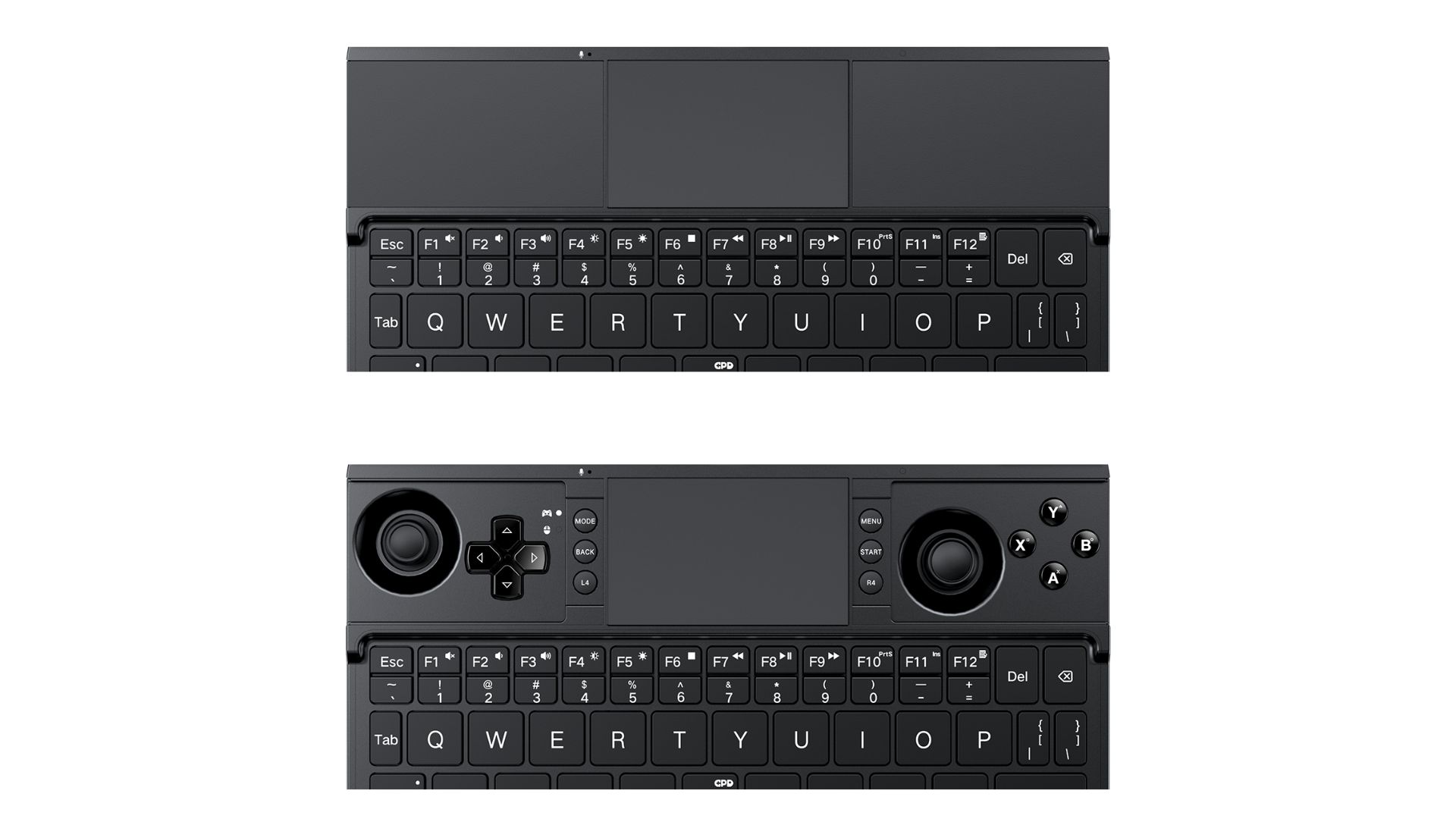
The magnetic joystick cover continues one of the most practical Max-series ideas. It hides the game controls when the device is being used in a meeting, office, or travel-work environment, making the system look more like a compact laptop than a controller-led handheld.
That matters because a portable gaming computer in this class has to support more than games. It also needs to be comfortable for typing, video calls, file management, browsing, remote work, and setup tasks without making the user carry a second laptop.
USB4, HDMI 2.1 and GPD G2 graphics dock support
The GPD WIN MAX 3 port selection is broad for such a small machine. Our sources list one USB4 port with DisplayPort 2.1 and 40Gbps bandwidth, one USB 3.2 Gen 2 Type-C port with DisplayPort 2.1 and 10Gbps bandwidth, two USB 3.2 Gen 2 Type-A ports, HDMI 2.1 FRL, a DC power port, a 3.5mm headphone jack, and the Mini SSD slot.
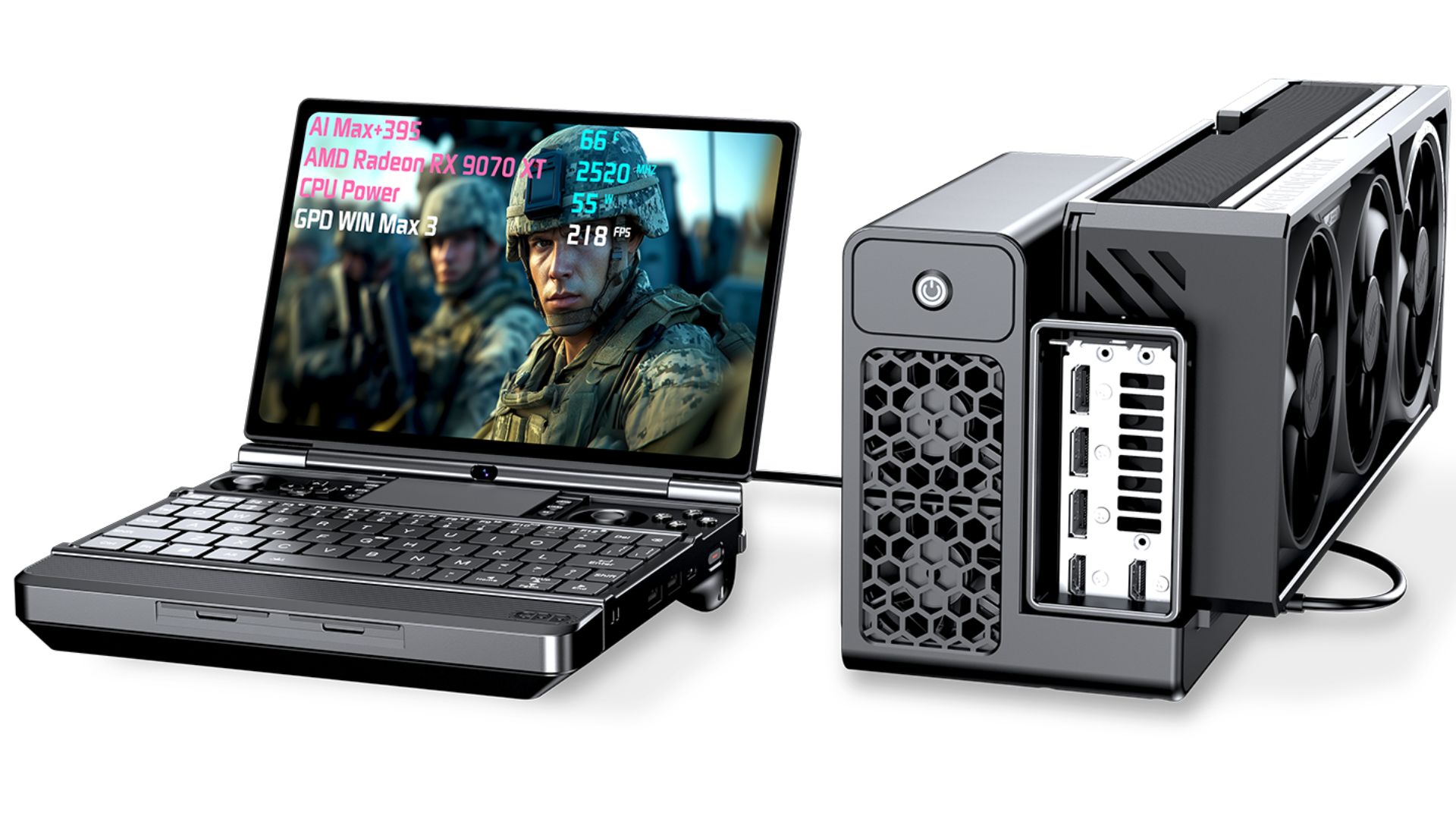
The supplied material also highlights support for the GPD G2 graphics dock over USB4. It claims that a GPD G2 dock fitted with AMD Radeon RX 9070 XT graphics reached a 3DMark Time Spy score of 20,272 through the WIN Max 3 USB4 connection, although that should be treated as a source-provided benchmark claim.
This expansion path helps explain who the device is for. GPD WIN MAX 3 may appeal to users who want one system for handheld play, external monitors, desk use, and more powerful docked gaming, rather than a smaller handheld that is mainly built around portable-only play.
GPD WIN MAX 3 vs GPD WIN MAX 2 2025: what changes on paper?
The supplied comparison sets the GPD WIN MAX 3 against the GPD WIN MAX 2 2025. The most important changes are the screen technology, CPU class, GPU scale, memory bandwidth, storage options, battery system, and modular cooling.
The WIN MAX 2 2025 remains the more conventional compact laptop-style option, with a 10.1-inch 60Hz LCD, Ryzen AI 9 HX 370 or Ryzen 7 8840U choices, Radeon 890M or 780M graphics, dual-channel LPDDR5 7500 MT/s memory, a built-in 67Wh battery, and OCuLink support. GPD WIN MAX 3 shifts to a 9.06-inch 165Hz AMOLED screen, Ryzen AI Max+ chips, Radeon 8060S graphics, quad-channel LPDDR5x 8000 memory, a modular 97Wh battery, and external fan module support.
| Feature | GD WIN Max 3 | GPD WIN MAX 2 2025 |
|---|---|---|
| Display | 9.06-inch 165Hz AMOLED | 10.1-inch 60Hz LCD |
| CPU options | Ryzen AI Max+ 395 / 388 | Ryzen AI 9 HX 370 / Ryzen 7 8840U |
| GPU options | Radeon 8060S | Radeon 890M / 780M |
| Memory | Up to 128GB LPDDR5x 8000 quad-channel | Up to 64GB LPDDR5 7500 dual-channel |
| Battery | 97Wh external swappable module | 67Wh built-in battery |
| Cooling expansion | External fan module listed | Not listed |
| Storage expansion | M.2 2280, M.2 2230, Mini SSD 1517 | M.2 2280, M.2 2230, SD and microSD |
Who is the GPD WIN MAX 3 for?
On paper, GPD WIN MAX 3 is aimed at users who want stronger performance and more expansion than a standard handheld, while still keeping the built-in keyboard, display, and controls that define the Max series. It sits closer to a pocketable workstation-gaming hybrid than a simple console-style handheld.
It may suit users looking for a mobile gaming PC for Windows gaming, emulation, external GPU docking, travel productivity, local AI experiments, and large storage libraries. It may be less suitable for players who want the lightest possible handheld, since the battery module configuration is listed at 1,220g.
The sensible approach is to wait for final pricing, retail SKUs, and independent testing before choosing between this, the GPD WIN 5, the WIN MAX 2 2025, or another Windows handheld. Even with that caution, the source material points to one of GPD’s most ambitious compact Windows systems so far.
GPD WIN Max 3
Windows Handhelds
Processor ModelRyzen™ AI Max+ 388
Memory / Capacity32GB
Storage / Capacity1TB
on 4 storesFinal thoughts on the GPD WIN MAX 3
The GPD WIN MAX 3 is shaping up as a significant Max-series redesign rather than a light refresh. The confirmed source-backed details include a 9.06-inch 165Hz AMOLED display, AMD Ryzen AI Max+ processors, Radeon 8060S graphics, up to 128GB LPDDR5x memory, three storage expansion routes, modular battery power, modular cooling, and a strong port selection.
The main caveat is that many performance figures still come from supplied source material. Until GPD Store or independent reviewers test final hardware, claims around sustained 110W operation, game frame rates, AI model performance, and external GPU scores should be treated as source-provided figures.
For anyone watching the next generation of handheld gaming PC hardware, the GPD WIN MAX 3 deserves close attention. It could become one of the most versatile Windows handhelds for buyers who want a portable gaming PC, compact productivity laptop, and expandable desktop-style setup in a single device.
FAQs
Has the GPD WIN MAX 3 been announced yet?
The GPD WIN MAX 3 has appeared in source material reviewed by GPD Store, but final retail details such as pricing, launch timing, regional availability, and SKU options still need confirmation. The specifications in this article are based on those sources and should not be treated as GPD Store hands-on testing.
What processor does the GPD WIN MAX 3 use?
The GPD WIN MAX 3 is listed with AMD Ryzen AI Max+ 395 and AMD Ryzen AI Max+ 388 processor options. Both are Zen 5 Strix Halo chips with a listed 45W to 110W dynamic TDP range and a 50 TOPS NPU.
Does the GPD WIN MAX 3 have a 165Hz AMOLED display?
Yes, our sources describe the GPD WIN MAX 3 with a 9.06-inch 2400×1504 AMOLED display, 165Hz refresh rate, HDR10 support, 313 PPI density, Real RGB sub-pixel layout, Gorilla Glass 6, touch support, and active stylus support.
Is the GPD WIN MAX 3 worth waiting for?
The GPD WIN MAX 3 may be worth waiting for if you want a high-power Windows handheld with a keyboard, OLED display, modular battery, modular cooling, and strong storage expansion. Buyers who prioritise low weight or verified benchmarks should wait for final reviews before deciding.
Can the GPD WIN MAX 3 be used as a laptop?
Yes, the GPD WIN MAX 3 is designed as a handheld gaming laptop with a keyboard, touchpad, camera, microphone, fingerprint power button, and magnetic joystick cover. It is intended to serve as both a gaming device and a compact productivity machine.










Questions & answers
4DUDE! Will there be a smaller battery that fits flush to the front edge or will we only get that monstrosity in the pics?
The GPD WIN MAX 3 hasnt been officially announced as yet. So we may see different options in the future.
Why not a 11 inch screen 9 inches isn’t max anymore 8.8 is pretty much the standard of most handheld s
It may be due to availability and cost. It is something only GPD could answer.
No vrr or adaptive sync ? Could be a deal breaker .
It doesnt support VRR.
Does the GPD Win Max 3 have cellular capability like the GPD Win Max 2?
The GPD Win Max 3 does not feature integrated cellular capability or a dedicated LTE module slot like the Win Max 2.
GPD revamped the physical design to focus on modularity for performance and power, such as magnetically attached external battery packs and active cooling fan modules rather than mobile connectivity modules. Because the manufacturer is not producing an LTE module for the Win Max 3, mobile internet requires tethering via a smartphone hotspot or using a standard external USB 4G/5G dongle